


Whenever I photograph garden plants I always try to find mature examples within gardens to illustrate what it will look like when the garden is fully realized. It is next to impossible to look at a plant in a nursery catalog or garden encyclopedia and get any real sense of how big it will become or how it might pair with other things in a garden.

Aloe flowering in the Desert Garden at Huntington Library
Aloes are a great case in point. For many of us our first exposure to Aloe might have been Aloe vera, a succulent with thick fleshy leaves that perhaps we have on a sunny windowsill for homeopathic medicine in relief of sunburn. But in a garden, especially a warm sunny Southern California garden with little worries for frost, they can get huge.
I first recognized the importance of showing plants in scale when I photographed the Hardy Succulents book, (still in print and available in our store). My co-author, Gwen Kelaidis, an alpine garden specialist in Colorado, did not want me to photograph anything in California. She knew it would be misleading to gardeners in colder parts of the country where succulents in general never get as large as California grown. Because aloes really are quite tender we didn’t use them in the book anyway, but the lesson was learned, a good garden photo is not just eye candy it needs to inform.
The Desert Garden at the Huntington Library in San Marino, California has been growing aloes for 100 years. It is an awe inspiring garden of Dr. Seuss like plants. The 10 acre, beautifully maintained garden has allowedallowed the plants room to grow to full maturity so that a visitor can get a perspective of the plants among themselves. Here are more photos a post from 2023 on the Desert Garden.
The garden has just gone through a major upgrade and the beds around the Mary Alice Huntington Desert Conservatory have been renovated with some huge specimens. That same Aloe we saw above, here in context:

New garden beds in the Desert Garden at The Huntington Library
Now that’s starting to show some perspective ! It is definitely not a small plant.
I arrived in the early morning with the sun just clearing out the morning mist. It was a magical time. The large flowering Aloe was obviously a stand out and I wanted to find the best angle to set it apart from the busy textures around it.
This is exactly the time when a garden photographer should not feel hurried, now is the time to absorb the scene, take a deep breath and look. Indeed it’s in these times we can really see, and the camera gives us the photographer that opportunity to slow down and look carefully, especially with a tripod which I always use, as much for technical reasons and sharpness as for contemplation and composition.
In order to get the specimen shot, the kind of in situ garden photo I like to use to illustrate plants, I only had to move a little bit, to place the flowering aloe in a somewhat open space under the huge tree Aloe in the distance, zoom in a bit with the lens, and then set the aperture so that everything was not super sharp. I only wanted the aloe to be crisp.
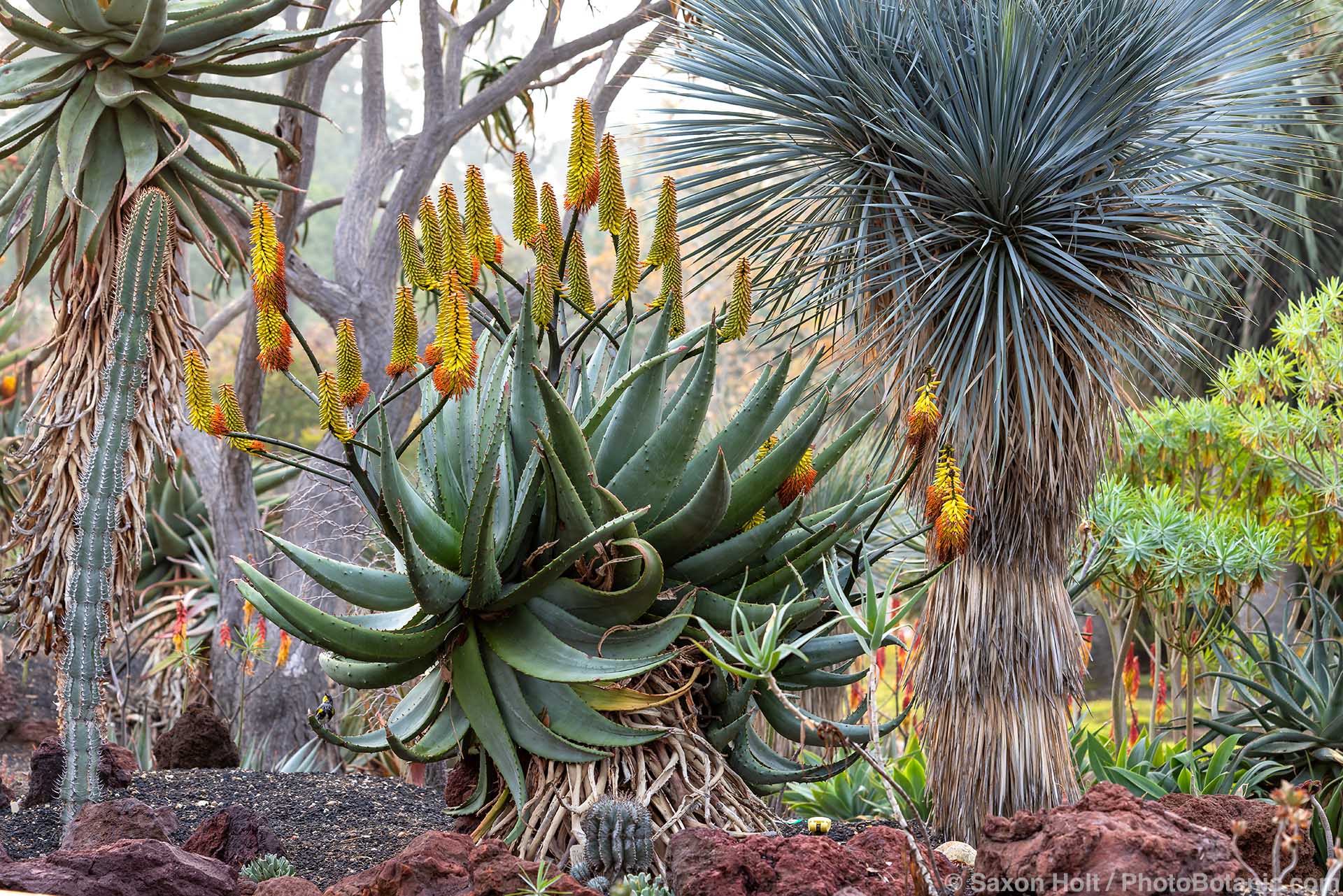
Flowering aloe in the Desert Garden at The Huntington Library
As I admired the Aloe through the camera and contemplated a close-up shot of the flowers a bird flew in. Did you see it camouflaged in that opening picture ?

Yellow rump warbler singing in flowering Aloe; The Desert Garden at The Huntington Library
I am sure that Yellow-rump Warbler had a different perspective than I did.



Leave A Comment