

“Do garden magazines and books—and the photography in them—mislead readers and create unrealistic expectations?” was the recent query from a garden industry friend.
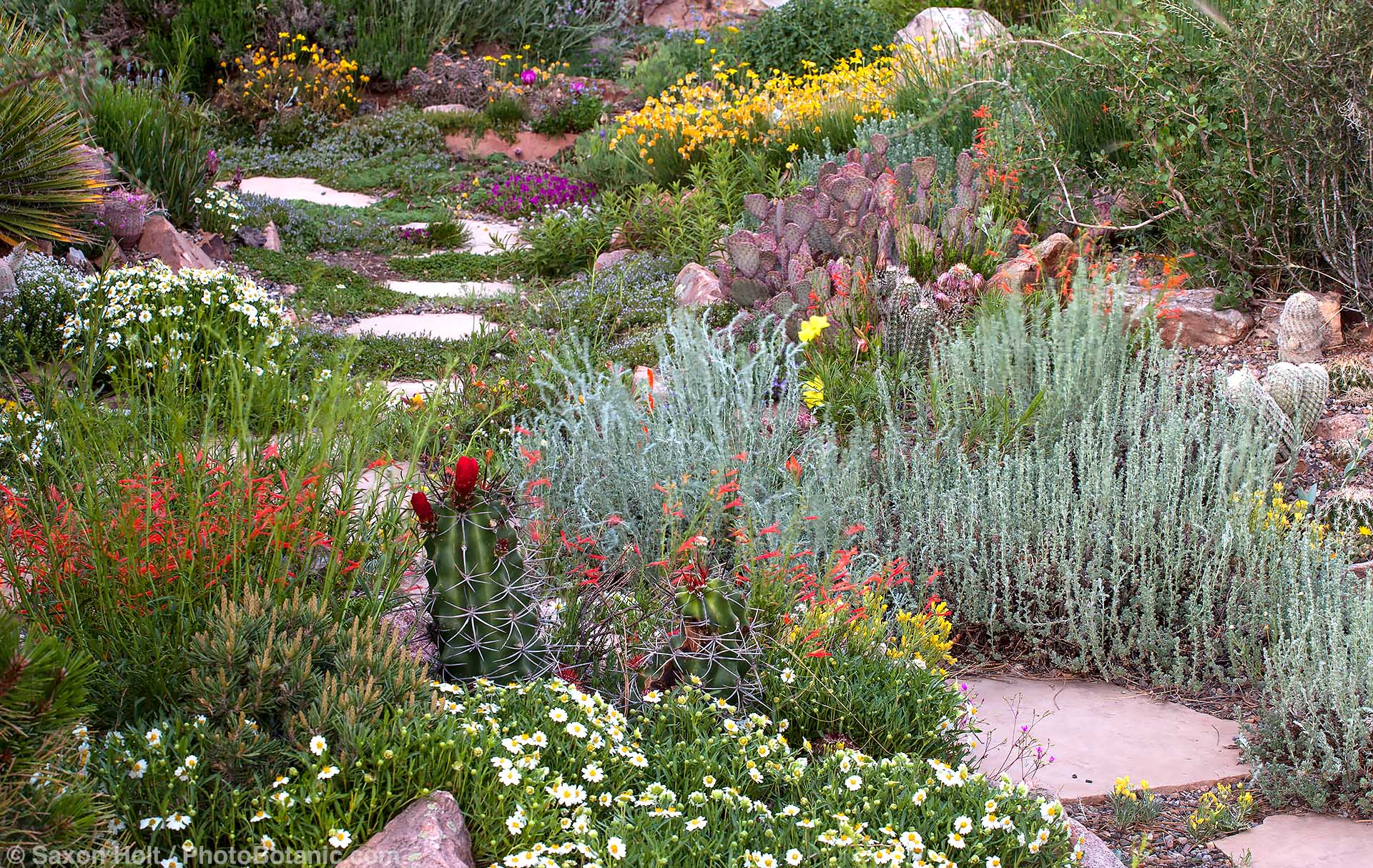
David Salman xeric New Mexico rock garden – climate adapted !
I have been talking about this issue for decades in my personal blogs and various contributions to gardening sites. I almost always talk about unrealistic expectations when I make presentations. When I was blogging with Gardening Gone Wild my tag was “The Camera Always Lies”. Photographers and their editors tell the story they want you to see, don’t expect it to be the whole truth.
Amy Stewart of Garden Rant once called me out and said “Are these images misleading? Do they set gardeners up for unrealistic expectations and, ultimately, disappointment and feelings of inadequacy ?” It all depends: Where you see the photo and where you garden are just as important as how you see the garden in the published photograph. Without interjecting the potential of AI to create unrealistic expectations, do a bit of critical thinking when you see a garden photograph. Is it a do it yourself book ?, a slick lifestyle magazine ?, a nursery ad?, a design studio website?
In my e-book good Good Garden Photography I went out of my way to explain ‘good’ is to be seen in context. “A good photo is easy to look at and tells a story—a story the photographer wants to tell.” For garden communication, a good photo tells a specific story of place — of the exact place where the photographer set up, not necessarily applies to your garden.

Modern home with stone patio and native plant garden with Quercus agrifolia oak trees framing Pacific Ocean

Flowering woodland groundcover lawn substitute, Pennsylvania
The power of pictures is in creating an expectation of truth that “the camera doesn’t lie” which is not what photographers do as they manipulate timing, camera angles, and composition. Readers of garden magazines need to use a bit of critical thinking when they see a photo. Does that garden photo apply to where you garden?
Whatever truth garden photographers think we are showing with our photographs is heavily influenced by our own eyesight, biases, and beliefs. We edit to show what we think is important to our story as photojournalists but that’s never the whole truth. The most obvious illustration of selective editing in photojournalism is portraying a politician’s photo in the news media. My goodness there’s so many ways a photograph can create expectations and perceptions. We edit out what we think is important, and then editors decide what they think is important, and the viewer has often no clue of how many decisions went into showing a specific image.
Garden books and publishers do not intend to mislead readers, they want to inspire them. They are showing a certain kind of a truth in a specific publication; what really needs to happen is some critical thinking by readers to recognize what they were actually looking at, and like anything, have multiple sources in deciding what is realistic for their own garden. The more we learn the more we need multiple sources. One photo is not a garden’s story.
When I was first learning to be a garden photographer it took me 10 to 15 years to even realize I was reinforcing a garden aesthetic that I had learned growing up on the East Coast, and recognizing the dominant media aesthetic was (is?) very European biased. A garden publisher in New York or England is not considering that they might be misleading a gardener who lives in a summer-dry climate, where I now work. They make an assumption, fair or not, that the reader is in the same climate as the publisher, or where the garden photo was taken.
This is where it really becomes difficult to pinpoint a realistic garden because the reader may actually be fully aware that they are far away from the beautiful garden they see in the magazine, but they still want it. They don’t make the connection that it’s not really a sustainable vision.

Path leading through succulent garden with flowering Aloes at Aloes in Wonderland in Santa Barbara, California
I had a bit of an epiphany working on my Hardy Succulents book when my co-author and writer Gwen Kelaidis asked me not to photograph succulents in California because they grew so large and it would be misleading for the Hardy succulent audience she intended as an expert on rock gardens and alpine plants. Her comments also led me looking for mature gardens in general, ones that have been sustained, have some lessons already learned, to show gardeners plants grown into their real place, not recently planted from a nursery container. As in the Santa Barbara garden above, I want to show gardens that have grown in.
Gardening is also hard and takes work, and the “unrealistic expectations” in gardening publishing come as much from people not recognizing the work it takes to create a photo-worthy garden as it is from having unrealistic visions. I remember being somewhat amused, or bemused, when I was speaking years ago for my book The American Meadow Garden. Gardens meadows are really hard to create and maintain, and take a lot of work – that whole book may have been creating a set of unrealistic expectations even though the aesthetic was timely and ecologically important. I did not necessarily cringe when I heard the enthusiasm about this ‘low maintenance’ garden style but…

Meadow garden in morning light through walnut tree at River Farm, Virginia, American Horticultural Society
As I say gardens are hard and take work – but definitely easier if you match the garden to the garden’s exact location on the planet.
An equally important issue in understanding the “unrealistic” gardens we see in the media is recognizing that the garden we see portrayed has been created by folks with the means to maintain them. (Note the two expansive gardens in California and Pennsylvania in the begining of this post).
This speaks not only to the work required to create the garden and acquire the uncommon plants we often see illustrated, but the ongoing maintenance to “sustain” it and budget for the ongoing expenses of tree work and pruning; irrigation systems and repair; path, fence, and patio upkeep; and often hired help for weeding, mulching, etc. That beautiful garden you saw in the photograph ? It is a culmination of a lot of inputs – and the photographer being in the right place at exactly the right time.
Most of my favorite gardens these days are almost entirely the work of a single passionate gardener who has no other hobby (or other life if I were not being so charitable 😇). These gardeners may be obsessive but I know the gardens are real and possible, even if incredible talent is required.
David Salman garden with silver foliage Artemisia frigida, Penstemon pinnifolius, Melampodium (Blackfoot Daisy) and Claret-cup cactus, Echinocereus triglochidiatus
As a plant nerd myself I really like photographing gardens of plant collectors and nursery people such as David Salman’s famous garden in New Mexico. These sort of horticultural wonderlands find their way into print more often than any regular garden, and their talented creators are often modest and hardly realize their skills are not really transferable to realistic gardeners.
However, we do often see well groomed gardens of the rich and famous in some of the slick publications – gardens maintained by staff, and primped and styled just for a photo shoot. These stories are not meant to tempt the casual garden and are more voyeuristic than practical – and we should know that.
And yes sometimes photos are contrived hoping the reader believes it is genuine while the publisher and photographer are simply hoping to inspire.
I spent hours creating this next photo using containers of nursery plants for a wildflower book. I confess this is purposefully pretending to be photojournalism, but it was a commercial photo shoot with stylist for a publisher. Creating photos like this is far too time consuming and costly for photojournalists and for the vast majority of garden photos you see, but is another reason to put on your critical thinking hat when you look at any photograph.

Wildflowers – Rudbeckia, Gaillardia and Echinacea in 5 gallon cans to create garden bed
So when Amy asks: “Are these images misleading? Do they set gardeners up for unrealistic expectations and, ultimately, disappointment and feelings of inadequacy ?” It all depends on where are you are seeing those images – in what type of publication and where the garden was actually photographed, as it also depends on where you garden and how much work you’re willing to do.
I have come to a nice balance in my own garden so that I no longer feel disappointed or inadequate. My garden is large, a full acre and has 18 different irrigation stations, and at least six distinctive garden rooms with interesting plants in all of them. I suppose now in retrospect I created more than I can actively manage … but I do what I can do and love doing it. I also don’t expect to look like a photograph, which is another unrealistic expectation of garden envy that many gardeners bring to viewing other gardens.
Now my job with The Summer-Dry Project is to help match gardeners with plants and have success in summer-dry climates in particular. Those photos certainly do not apply to any gardener, and I don’t feel I need to explain that. I find examples that are beautiful and regionally appropriate, then perhaps my carefully edited professional photos can add to the lie that it looks easy. Ultimately I do want to inspire gardeners to have success by showing success, and it’s a matter for the individual gardener to be realistic in doing the work.



Leave A Comment